Blog
All posts including articles and notes. (2831 total)
-
Claude code vs Opencode token overhead
https://systima.ai/blog/claude-code-vs-opencode-token-overheadPermalinkInteresting read I want to come back later
-
Ableton on Linux
https://post.lurk.org/@shibacomputer/116892289767858341PermalinkGotta check this later… Cos the only reason I bought this Geekom IT15 was to run Ableton.
Now if I can do this on my framework 16 I’d jump on the occasion
-
Testing Phandroid via Obtainium/F-Droid
This post is published through my Micropub endpoint, which creates a new entry in MongoDB. Eleventy then retrieves that entry during the build process and generates a static version of the post.
Any reactions or replies should trigger a Webmention, which is then received and processed by my Indiekit site.
-
Il y a quelque chose d’absurde dans notre manière de répondre à l’urgence climatique. À chaque nouvelle canicule, on nous parle de volets, d’isolation, de climatisation, de fontaines, de piscines publiques temporairement accessibles et de quelques ar...
Read more → -
https://da.van.ac/sony-playstation-disques-propriete-physique-films-jeux/Permalink
quand la puissance publique choisit l’autorégulation, c’est l’acteur dominant qui fixe les règles, et il les fixe à son avantage.
Le futur c’est les décisions et l’inertie d’hier couplée à l’inertie d’aujourd’hui.
-
L’accord Rossel–IPM pose les fondations d’un affaiblissement durable de la presse locale et régionale en Belgique.
Ce scénario n’a rien de nouveau. Aux États-Unis, la disparition massive des journaux locaux a précédé l’apparition de véritables déserts informationnels, laissant des territoires entiers sans contre-pouvoir journalistique, sans enquête de proximité et sans surveillance réelle des pouvoirs politiques et économiques. Le résultat est connu : la viralité de la désinformation via les réseaux sociaux, davantage de désinformation, moins de participation démocratique et des institutions locales plus facilement capturées.
La France suit une trajectoire comparable : concentration croissante des médias, recul du pluralisme, marginalisation des rédactions indépendantes et uniformisation progressive du débat public. Quelques grands propriétaires décident de plus en plus de ce qui mérite d’être visible, discuté ou ignoré. Cette concentration ne suffit pas, à elle seule, à expliquer la montée de l’extrême droite, mais elle contribue à créer un espace médiatique où ses thèmes, ses obsessions et son vocabulaire finissent par devenir omniprésents.
Pendant ce temps, une caste politique et économique toujours plus étroite conserve l’accès aux plateaux, aux éditoriaux et aux leviers de décision, tandis que le reste de la société devient progressivement invisible.
Couplée à une répression systématique des mouvements sociaux et une criminalisation constante de toute forme de manifestations, désobéissance civiles, c’est la porte ouverte à une dégénérescence démocratique sans retour.
La Belgique, une fois encore, semble choisir de reproduire les mauvaises idées déjà testées ailleurs : sacrifier la diversité éditoriale, l’indépendance des rédactions et l’information de proximité au nom de la sacro-sainte rentabilité.
Mais la presse n’est pas une industrie comme une autre. Son utilité ne se mesure pas uniquement à ses marges, à ses abonnements ou à ses économies d’échelle. Une démocratie saine a besoin de rédactions nombreuses, indépendantes, concurrentes et suffisamment financées pour enquêter, déranger et rendre visibles des réalités que les grands centres de pouvoir préféreraient souvent maintenir dans l’ombre.
Quand toute la presse quotidienne francophone finit par dépendre du même groupe, le problème n’est pas seulement économique.
C’est une menace directe contre le pluralisme démocratique.
-
The United States’ 250th birthday celebration looked less like a national commemoration than a cheap, Trump-centric political rally, detached from the everyday reality of millions of Americans.
Independence Day increasingly feels repurposed as a celebration of one man rather than of a republic.
If that trajectory continues, the real test will not be the fireworks but the midterms: whether democratic institutions remain capable of constraining executive power, or whether political retaliation, institutional erosion, and the concentration of power become [the new normal.] (https://www.theatlantic.com/politics/archive/2016/07/opioid-of-the-masses/489911/)
The measure of a democracy is not how loudly it celebrates its founding, but how well it protects the institutions meant to outlive any president.
The 250th edition of independence Day was a tragic display of ignorance, cupidity and political sectarianism orchestrated by the Trump elected regime.
-
Tournage avec France 2 affaires sensibles pour chardonsbleus.org
-
 Permalink
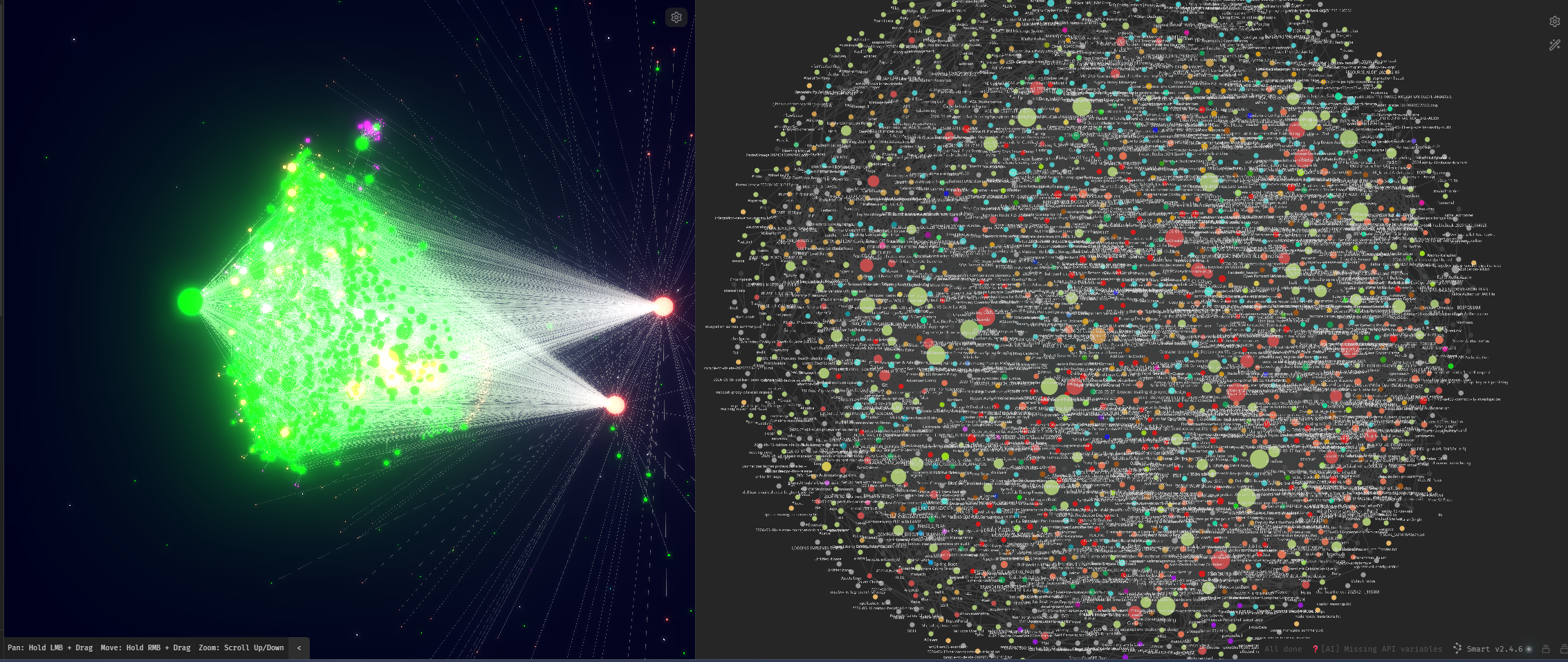
I’d been putting off properly tagging my Obsidian vault for years — over 800 notes accumulated with no consistent structure, just a pile of clippings, quick references, and dumped chat exports. Classic case of “I’ll organize it later.” it.
The approach: rather than trust a single AI pass blindly, I built a small classification pipeline and validated it in stages. First, a discovery run over a sample of notes with no fixed categories — just “what is this actually about?” — to see what topics and tags naturally emerged from the data itself, instead of guessing a taxonomy up front. Once a sensible set of categories settled out, I locked it in and ran the classifier against a bigger slice of the corpus, checked the results by hand to make sure the model wasn’t hallucinating or defaulting to generic buckets, and only then let it loose on the entire vault.
Once that pipeline was proven out, I pointed it at something meatier: a full year’s worth of markdown files generated by Claude Code sessions — specs, audits, plans, reports, incident write-ups — and ran the exact same enrichment process against it. Same local model, same classify-then-verify discipline, just a different (and much denser) corpus. Nice validation that the pipeline generalizes beyond “lazily tagged personal notes” into real working documentation.
-
Most of the talk about RSS is about publishing. A feed is something your site emits: you write a post, and the feed is the machine-readable copy that goes out the door. Almost every blog does this. It is the easy half, and it has been solved for twen...
Read more → AI: T2 -
Permalink
I run one: rmendes.net, built on Indiekit (an open-source IndieWeb server) plus a set of plugins I maintain. It does both directions
-
J’ai reçu un spam pour le renouvellement de Norton anti-virus, d’un coup je me suis senti vieux :P
-
I don’t follow the games but I do follow US politics and obviously the Trump regime wouldn’t miss that one.
FIFA loves to pretend football and politics should never mix.
Adorable.
By allowing the U.S. government to treat Iran as a political target during the World Cup, FIFA did not stay neutral. It simply outsourced the dirty work to the host country.
And in doing so, it created a precedent.
Future hosts now know the rule: use visas, borders and entry restrictions as political weapons, and FIFA will look the other way — provided the stadiums are shiny enough and the sponsors are comfortable.
There is no walking that back.
The “world’s game” is now apparently open to everyone, unless the host government behaves like a drunk bouncer.
-
La nuit a été rude…
-
There is something almost absurd in the way British politics often behaves as though replacing the Prime Minister will somehow solve the country’s deeper problems.
The ritual has become familiar. A Prime Minister arrives with promises of renewal, reform, and leadership. For a brief moment, they are presented as the person capable of steering the nation through its challenges. Yet before long, the machinery surrounding them begins to grind into motion: factions within their own party, parliamentary rivalries, entrenched interests, and an information ecosystem dominated by outrage-driven media and tabloid narratives.
Public opinion, itself shaped by this relentless environment, turns against the Prime Minister. Every mistake is amplified, every compromise portrayed as weakness, every failure personalized. The Prime Minister becomes less a leader than a lightning rod, absorbing the frustrations of an increasingly dissatisfied public.
Eventually, the image of weakness becomes politically intolerable. Colleagues who once championed the leader begin distancing themselves. Internal rebellions emerge. Calls for resignation grow louder. The Prime Minister is discarded, replaced by a new figure who arrives promising a fresh start.
And then the cycle begins again.
What makes this process particularly striking is the assumption that changing the individual at the top can resolve problems that are fundamentally structural: stagnant productivity, regional inequalities, housing shortages, strained public services, demographic pressures, and a political culture increasingly driven by short-term media reactions rather than long-term planning.
The result is a political theatre in which the cast changes regularly, but the script remains largely the same.
As for #Brexit, it remains difficult to think of another modern democratic decision in which a nation voluntarily imposed such profound economic, diplomatic, and administrative costs upon itself while simultaneously convincing itself that doing so would restore control. Whatever one’s views on sovereignty, it stands as one of the most consequential acts of national self-harm in recent European history.

 post.lurk.org
 brennan.day
 da.van.ac
 manton.org
 doneyli.substack.com